By Anna Selman
In our house, the first thing the kids do when we get home from school is run to the mailbox. This happens before backpacks are unpacked, before shoes are put away, and certainly before anyone agrees to clean anything up. There is usually a brief argument about responsibilities, followed by me sorting through the mail while the kids hover nearby asking if anything is for them.
Every once in a while, I get to say the magic words. “Oh look,” I tell them casually. “You got a book from Harry.” The kids know exactly what that means. A PJ Library book has arrived.
We call the mysterious sender of our PJ Library books “Harry” because when the books first started arriving, it seemed easier than explaining Jewish literacy initiatives to small children. It also helps that I actually had an Uncle Harry growing up, which makes the whole thing feel plausible.
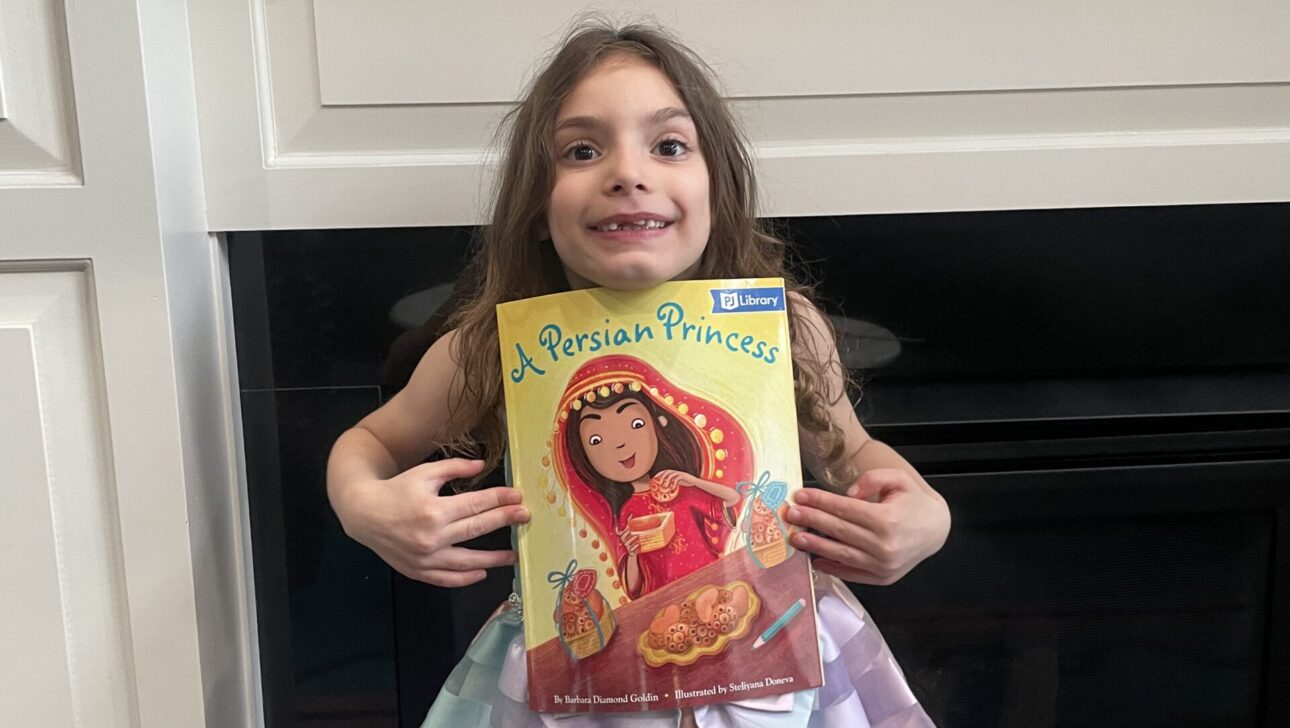
My daughter is six, currently missing her two front teeth, and deeply committed to the idea that this book belongs to her and not her brothers. She opens it right there on the living room floor, flipping through the pages before immediately asking two things: “Can we read it?” and “Can I have a snack?”
Last month’s book was A Persian Princess by Barbara Diamond Goldin.
The story follows a young girl named Raya preparing for Purim with her grandmother—her maman joon. Together they bake Koloocheh cookies (traditional Nowruz cookies) while Raya dresses in a beautiful red and gold Persian outfit inspired by Queen Esther. My daughter loved it immediately.
She left the book on the coffee table the entire holiday, which in our house is the highest honor a children’s book can receive. At one point she pointed to the illustration of Raya’s dress—a bright red and gold creation that sparkled across the page—and asked if she could get one like it. She has recently entered the phase of life where being “beautiful” is a daily priority and where sparkle eye shadow has been formally requested. But Persian princess dresses are not exactly easy to find in Cincinnati, Ohio.
I grew up in Southern California, where Persian culture was simply part of the landscape. One of the things I miss most are the bakeries. Not just a bakery with the Koloocheh that the book mentioned, but glass cases filled with rows of golden sweets in every shape imaginable—clovers, crescents, circles. The air smells like cardamom, saffron, and rosewater. I miss being able to buy boxes of Persian cookies without thinking about it. Now that I live in Cincinnati, if I want something Persian, I usually have to make it myself.
The closest thing we have here is Jungle Jim’s, the Disneyland of grocery stores. Jungle Jim’s technically has a Persian section, though it mostly consists of spices and tea. The real trick is finding the one employee who actually knows where everything is. Persian ingredients are scattered across different “countries,” so if you’re looking for saffron, rosewater, or cardamom, you have to embark on something of an international scavenger hunt.
Reading A Persian Princess reminded me how rarely we see stories like this. Most Jewish children’s books center on Ashkenazi traditions, which are wonderful—but they are not the whole Jewish story. Persian Jews belong to one of the oldest Jewish communities in the world, with a history that stretches back to the time of Queen Esther herself. The tomb of Mordechai and Esther still stands in Hamadan as a reminder of that legacy.
For many families like mine, Persian culture shows up quietly—in the food we cook, the smells in our kitchens, the occasional unwaxed Persian unibrow that slips out after a month of neglect. My son has inherited the unmistakable Persian unibrow. Once a month we stand him in front of the mirror and make sure it becomes two eyebrows again. I always tell him the same thing: “Those are Persian eyebrows.” He stands in front of the mirror proud of them.
My kids are still young, so they don’t watch the news. But they know something is happening in Iran. When it comes up, I tell them something simple: the people there are fighting for their freedom. Purim is about standing up to tyranny. Passover is about escaping it. Before the Iranian Revolution in 1979, around 80,000 Jews lived in Iran. Today fewer than 10,000 remain. Stories like A Persian Princess matter because they remind people that Persian Jews exist—that our traditions, food, language, and history are part of the Jewish story too.
This year, reading this little book right before Passover felt strangely perfect. Almost besheret.
Passover is the holiday where we sit around a table, eat aggressively dry bread, and tell the story of freedom as if we personally were there, which, according to the Haggadah, we basically were. Every year we remind ourselves that this isn’t just a story we inherited—it’s one we’re supposed to recognize as our own.
For my daughter, right now, that story doesn’t look like Pharaoh or plagues or even particularly strong opinions about matzah. It looks like a sparkly red dress, a grandmother baking cookies, and a book that arrived in the mail from someone named Harry.
It’s not a full understanding. It’s not supposed to be. It’s just the beginning—one small, slightly chaotic, snack-interrupted entry point into a much bigger story about who she is and where she comes from. And honestly, that’s about as good as it gets at six.
So thank you to PJ Library—and to Harry—for doing the heavy lifting and sending stories that manage to sneak identity, history, and a mild amount of cultural pride into our living room between snack requests.
This year, when most Cincinnati Jews say L’shanah haba’ah b’Yerushalayim—next year in Jerusalem—our family will quietly add another hope. L’shanah haba’ah b’Tehran. Next year in Tehran.